Animal-Based Amino Acid
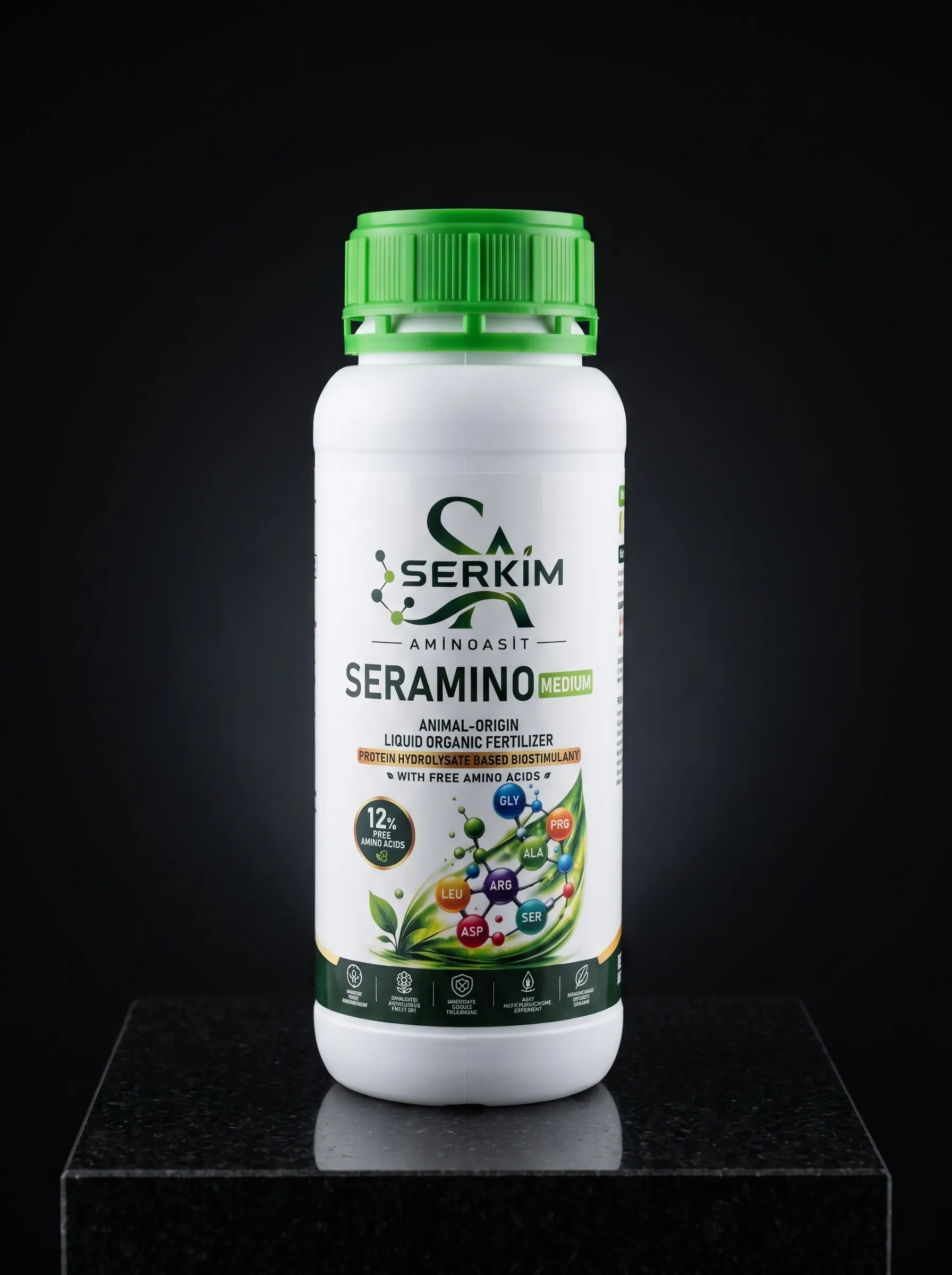
Ser Amino - Medium
Liquid Organic Fertilizer Containing Animal-Origin Amino Acids
Mid-segment solution providing strong support during flowering, fruit set and yield periods with a balanced free amino acid ratio.
- Free Amino Acid 12%
- Organic Matter 40%
- Organic Nitrogen 5%
- Low MW
- Registration No
- 12490
- License No
- 1785
- Packaging
- 7 options
Packaging: 0.5 L · 1 L · 5 L · 10 L · 20 L · 25 L · 50 L
Product Description
Ser Amino - Medium is a balanced liquid organic fertilizer containing 12% free amino acids, produced by the enzymatic hydrolysis of HALAL-slaughtered cattle hide collagen. It meets the plant’s increased amino acid demand during flowering, fruit set, fruit sizing and colouring.
Thanks to low-molecular-weight L-amino acids and short-chain peptides it ensures rapid uptake and supports the plant against stress conditions (cold, heat, drought, frost). See the application table below for crop-based application periods and doses.
Dominant amino acids
- Glycine
- Hydroxyproline
- Proline
- Alanine
- Glutamic acid
- Lysine
Guaranteed Content
W/W — registered values
- Organic Matter
- 40%
- Organic Carbon
- 15%
- Organic Nitrogen (N)
- 5%
- Free Amino Acids
- 12%
- Max. EC (ds/m)
- 14.5
- pH
- 5.5–7.5
Application Dose
Application amounts by crop group.
| Crop Group | Drip (cc/da) | Foliar (cc/100 L water) |
|---|---|---|
| Vegetables (tomato, pepper, eggplant, cucumber) | 600–700 | 250–300 |
| Fruit Trees (olive, pistachio, almond, pomegranate, grape, apple, pear, cherry, sour cherry, peach) | 1000–2000 | 250–300 |
| Field Crops (cotton, corn, soybean, peanut, rice, sunflower, tobacco, wheat) | 1000–2000 | 250–300 |
| Green Areas (cut flowers, ornamentals) | 1000–2000 | 250–300 |
| Citrus, Banana | 2000–3000 | 250–300 |
| Melon, Watermelon, Strawberry | 1000–2000 | 250–300 |
Application timing varies by crop group (in vegetables ~20-day intervals after the 3–4 leaf stage; in fruit trees 3–4 applications throughout the growth period). Doses should be adapted to a soil and/or leaf analysis.
Application Guide
Crop-by-crop timing and dose.
Field recommendations for Ser Amino - Medium. All recommendations should be adapted to a soil and/or leaf analysis carried out alongside the product.
Vegetables
Tomato
- At transplanting, 500–600 cc/da by drip; 15–20 days later 200–300 cc/da foliar.
- During the flower–fruit period, 500–600 cc/da by drip every 2–3 weeks.
- During fruit colouring and sizing, 200–300 cc/da foliar.
Pepper
- From planting to harvest, 400–500 cc/da by drip.
- Yield-boosting applications, 200 cc/da foliar.
- 3–5 leaf stage 200 cc/da foliar; start of flowering 250 cc/da foliar.
- First fruit set 300 cc/da by drip; every 3 weeks 250 cc/da foliar.
Eggplant
- From planting to first flowering, 500–600 cc/da by drip.
- From flowering to fruit set, 500–600 cc/da by drip.
- From start of flowering, 250–300 cc/da foliar every 2 weeks.
Cucumber
- After transplanting, 200–400 cc/da by drip every 2 weeks.
- When first fruits reach hazelnut or walnut size, 300–400 cc/da foliar.
- At the start of first harvest, 500–600 cc/da by drip.
Onion
- Until harvest, 500–800 cc/da by sprinkler every 15 days.
- Single yield-boosting application, 1000 cc/da by sprinkler.
- From start of flowering, 250–300 cc/da foliar every 2 weeks.
Cabbage
- When leaves start to form, 500–750 cc/da by drip.
- Until plants reach 15 cm, 250–300 cc/da foliar.
- From 15–20 cm height until harvest, 500–750 cc/da by drip.
Green Bean
- Germination period, 150–200 cc foliar.
- Flowering and fruit-set period, 500–600 cc/da by drip.
- Before harvest, 800–1000 cc/da by drip.
Okra
- Flowering period, 200–300 cc/da foliar.
- Fruit-set period, 500–600 cc/da by drip.
- Before harvest, 2 applications of 500 cc/da by drip.
Fruit Trees
Grape
- To promote flowering and berry set, 500 cc/da by drip.
- Fruit-set and sizing applications, 500 cc/da by drip.
Olive
- To raise content concentration, 500 g–800 cc/da by drip.
- To increase fruit yield, 200–250 cc/da foliar.
- In March or early spring, 250 cc/da foliar together with sprays.
- Shoot period 250 cc/da; right after fruit set 200 cc/da foliar.
Peach
- Flowering period, 750–1000 cc/da by drip.
- Fruit-sizing period, 600–700 cc/da by drip.
Pear
- Before flowering, 250–300 cc/da foliar together with sprays.
- After petal fall, 1000–1200 cc/da by drip.
- May–June 200–300 cc/da; July–August 200–250 cc/da foliar.
Apple
- Up to mouse-ear stage 200 cc/da; pink-bud stage 150–200 cc/da foliar.
- From flowering to fruit set, 500–600 cc/da by drip.
- Until fruits reach walnut size, 500–600 cc/da by drip.
- Fruit sizing and colouring period, 300–500 cc/da by drip.
Cherry
- Pink-bud stage, 250–300 cc/da foliar.
- When 5–25% of flowers are open, 200–300 cc/da foliar.
- Pit-hardening period, 500–800 cc/da by drip.
Apricot
- Mouse-ear stage, 250–300 cc/da foliar together with sprays.
- Pink-bud stage, 200–300 cc/da foliar.
- When 70% of petals have fallen, 500–600 cc/da by drip.
- From chickpea size until harvest, 700–800 cc/da by drip.
Plum
- At bud break, 300 cc/da foliar together with sprays.
- From start of flowering until fruits reach walnut size, 700 cc/da by drip.
- During fruit colouring, 700–800 cc/da by drip.
Pomegranate
- When leaves first sprout, 300 cc/da foliar.
- During fruit set, 500 g–600 cc/da by drip.
- Until harvest, 3 applications of 600 cc/da by drip.
Field Crops
Potato
- With the seed 400–600 cc/da, with hoeing 500 cc/da.
- As fertigation 400 cc/da, foliar by sprinkler every 3 weeks.
- After sowing or transplanting, 300 cc by sprinkler.
- When tubers are 2–3 cm, 400 cc by sprinkler every 3 weeks until harvest.
Wheat
- Before and after tillering, 150–200 cc/da foliar.
- Stem elongation period, 200–300 cc/da foliar.
Corn
- During growth and development, 500–700 cc/da by drip or flood irrigation.
- Flowering period, 500–600 cc/da by drip and spray gun.
- Milk and grain maturity period, 500–600 cc/da by drip or flood irrigation.
Sunflower
- 1000–1500 cc/da with a spray gun, together with fertilizers applied at or before sowing.
- When plants reach 25–30 cm, at hoeing height, 200–250 cc/da with a spray gun.
- 2 applications of 400–500 cc/da until harvest, by flood or sprinkler irrigation.
Bean (Dry)
- Single yield-boosting application of 1000 cc/da by drip or flood irrigation.
- From start of flowering, 150–200 cc foliar every 2 weeks.
Sugar Beet
- Into the seedbed, 1000–1200 cc/da.
- At the 8–10 leaf stage, 500–700 cc/da.
- Until harvest, 4 applications of 200–250 cc/da foliar.
Melon · Watermelon · Strawberry
Melon
- Yield-boosting application, 400–600 cc/da by drip.
- To promote flower and fruit set, 500 cc/da by drip or flood irrigation.
- 3–5 leaf stage 500 ml/da; when fruits reach 100–200 g, 250 cc/da foliar.
Strawberry
- Emergence of flower clusters and flowering, 200 cc/da foliar.
- Fruit formation, 500 g–600 cc/da by drip.
- Runner formation, 500–600 cc/da by drip.
- Tillering period, 300–350 cc/da foliar.
Watermelon
- Seedling period, 500–600 cc/da by drip.
- Before flowering, 300 cc/da foliar together with sprays.
- From walnut size until maturity, 700 cc/da by drip.
Citrus & Banana
Banana
- To promote flowering and finger formation, 500–1000 cc/da by drip.
- Fruit-set and sizing applications, 800 cc/da by drip.
- At bunch emergence, 250 ml/da foliar.
- 15 days after bunch emergence, 250 ml/da foliar.
Citrus (Orange)
- To promote flowering, 750–1000 cc/da by drip.
- To improve fruit set and quality, 600–750 cc/da by drip.
- To increase yield and reduce fruit drop, 400–600 cc/da by drip.
- During flowering 200 cc/da; when fruits are 2–3 cm across 250 cc/da foliar.
Green Areas & Ornamentals
Rose
- Before pruning, 200 cc foliar.
- After pruning, 250–300 cc foliar.
- During shoot growth, 200–300 cc foliar.
Carnation
- Before and after planting, 500–600 cc/da by drip.
- Until cutting, one application per week of 200–300 cc foliar.
Mixing & Special Applications
Mixing Ratios
- With liquid organic fertilizers, 10–50%.
- With liquid amino-acid fertilizers, 8–24%.
- With liquid seaweed products, 10–14%.
- With liquid urea, phosphorus and potassium blends, 5–50%.
- With liquid mineral blends (boron, molybdenum, zinc, etc.), 5–50%.
- With liquid seaweed and humic-acid fertilizers, 5–30%.
- With compost and pellet fertilizers, 4–10%.
- Sprayed into farmyard manure, 1–5%.
- With granular organomineral and organic fertilizers, 4–10%.
- As a growth medium for live-microorganism products, 7–14%.
- With biopesticides, 2–13%.
- With organic pesticides, 1–10%.
Stress & Special Applications
- To prevent fruit drop, 200–300 cc/da.
- To prevent breakage in the upper canopy, 150–200 cc/da.
- To prevent fruit cracking and drop, 3 applications of 200 cc/100 L.
- To improve fruit set and uniform bud break, 2 applications of 200–300 cc/da.
- To improve calcium mobility, 300 cc/da; with calcium solutions, 5–10%.
- Under high heat stress, 200–300 cc/da; under temperature-change stress, 200 cc/da.
- When nutrients cannot be taken up, 200–300 cc/da.
- When chlorophyll synthesis fails, 250–300 cc/da together with Mg.
- To promote rooting, 400–500 cc/da by drip together with IAA; alone 700–1000 cc/da by drip.
Safety & Use
Safe application notes.
- Do not exceed the recommended dose; use the product only where needed.
- Read the product label before use.
- Wear protective gloves and a mask during application.
- Keep away from children and foodstuffs.
- In case of skin or eye contact, rinse with plenty of water.
- A soil and/or leaf analysis is recommended.
Caution: Not for human or animal consumption. Do not graze animals for at least 21 days after application; mown grass must not be used as animal feed.
Storage: Keep in its original packaging, in a cool, dry place away from direct sunlight. Under normal conditions (5°C–35°C) it retains its properties for at least 3 years.
Analysis & Registration
Downloadable documents
Independent accredited analysis reports and Republic of Türkiye Ministry of Agriculture and Forestry registration certificates.
Product Family
Other products.
Request a sample and technical support for your dealership.
Contact our team for product selection, dosage and an application plan.